Add 2 more items to unlock your free mystery gift.
Complimentary item.
Total
Recommended add-on
Home/Value vs. Premium: Is the $43 Opinel No.08 Black Oak Really Twice the Knife of the $22 Carbone?
Value vs. Premium: Is the $43 Opinel No.08 Black Oak Really Twice the Knife of the $22 Carbone?
Few knives in the world can claim a more loyal following than the Opinel No.08. It's been in production in one form or another since Joseph Opinel patented the Virobloc locking collar in 1955, it's carried daily by millions of people, and — crucially for today's comparison — it exists at two very different price points that look almost identical on the outside.
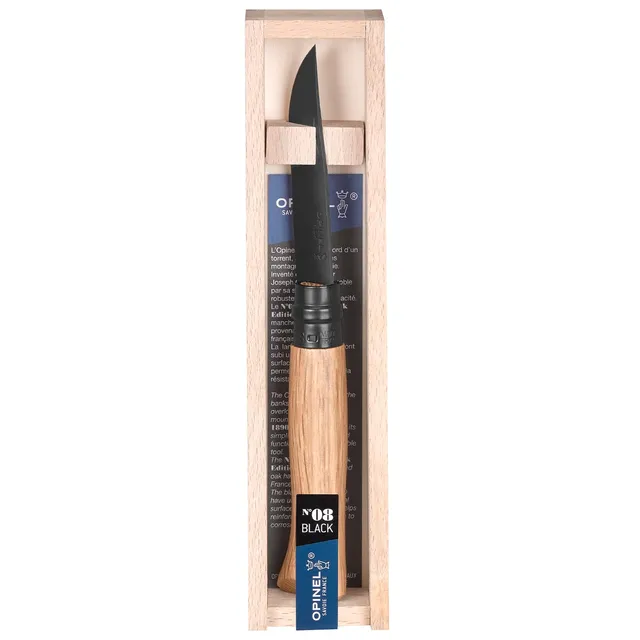
At $22.16, the carbon-steel No.08 Carbone is the value benchmark of the entire folding-knife world. At $43.12, the black oak edition with a coated stainless blade is the premium interpretation of the same knife. That's roughly double the money for the same silhouette, the same Virobloc lock, and the same French factory in Chambéry. So the question every buyer eventually asks is simple: is the premium No.08 actually worth it, or is the Carbone the smarter buy?
We've carried both, cut with both, and cared for both over months of daily use. Here's the honest breakdown.
Strip away the marketing and the price difference comes down to three things: blade steel, handle material, and finish.
1. Blade steel: character vs. convenience
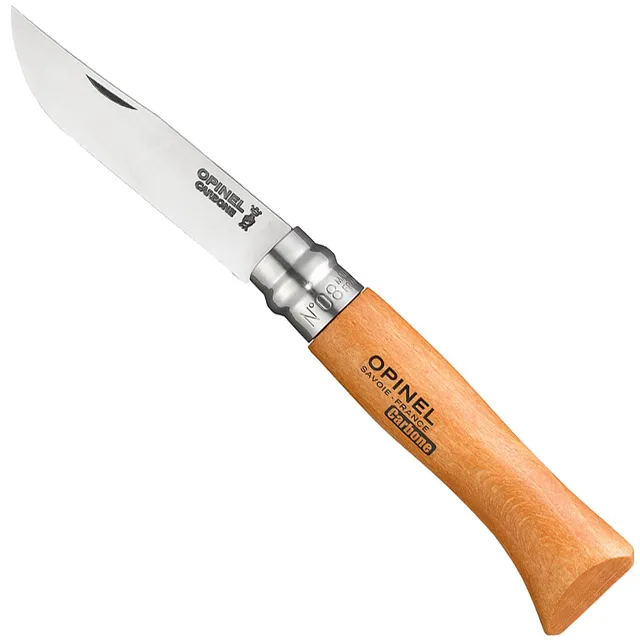
The Carbone uses Opinel's XC90 carbon steel — the traditional choice that's been ground in the Savoie workshops since the 1890s. It's genuinely easier to get scary-sharp than stainless, and it holds a fine, aggressive edge that many knife people still prefer for food prep and woodcraft. The trade-off is rust. Leave a carbon blade wet, and it will spot within hours. Over time it develops a gray-brown patina that protects the steel and, frankly, looks great — but you have to want that, and you have to wipe the blade after use.
The premium knife flips the equation: 12C27 stainless steel with a black PVD-style coating. It shrugs off moisture, requires almost no maintenance, and the coating gives it a modern, understated look. The coating will show wear on the edge bevel over years of hard use — that's normal — but the steel underneath is fully corrosion-resistant either way.
2. Handle: beechwood vs. black oak
Both knives use natural French hardwoods. The Carbone's beech handle is the classic Opinel look — light, warm, and honestly a little plain. The black oak handle is denser, darker, and grained with visible character; no two look the same. It's the single biggest visual reason to pay the premium, and it photographs like a knife twice its price.
3. Finish and gift-ability
The black oak edition is finished to a higher standard out of the box — darker hardware, a more considered palette, a knife you'd hand over as a gift without a second thought. At $43.12, it sits comfortably in the sweet spot for gifting: distinctive, French-made, and premium-feeling without crossing into collector pricing.
The Case for the Value Buy: No.08 Carbone
There's a reason the Carbone has accumulated nearly 12,000 reviews averaging 4.7 stars. It's the knife you don't baby. Lost on a hike? It's $22. Lent to a friend? Fine. Thrown in the truck toolbox? It'll patina and keep working. For anyone learning to sharpen, learning knife care, or simply wanting a genuine working tool, carbon steel is the better teacher — and at $22.16, the Carbone is arguably the best value-to-performance ratio in cutlery, full stop.
If you're willing to spend five seconds wiping the blade after each use, you'll be rewarded with an edge that outperforms the stainless option and a patina that makes the knife uniquely yours.
The Case for the Premium Buy: Black Oak No.08
The premium knife earns its money in three scenarios:
Wet, humid, or coastal use. If your knife sees rain, boat decks, kitchen sinks, or a sweaty pocket, stainless is the correct steel. Period.
Gift buyers. The black oak and coated blade presentation reads as a deliberate, designed object — the version people ask, "wait, which knife is that?"
Buy-once carrying. If you want one knife, cared for casually, for the next decade, the low-maintenance stainless build is the more realistic daily companion.
One more honest note: the black oak version currently carries the same 4.7-star average across roughly 4,700 reviews as the Carbone. Nobody is disappointed by either. The premium version isn't better at cutting — it's better suited to a different kind of owner.
Verdict: Match the Knife to Your Habits, Not Your Budget
Premium isn't automatically better, and value isn't automatically a compromise. Ask yourself one question: will you actually maintain a carbon blade?
If yes — buy the No.08 Carbone at $22.16. You'll get the finest edge of the two, a beautiful patina, and more than $20 left in your pocket. It remains the value king.
If no — or if this is a gift — buy the black oak stainless at $43.12. You're paying for a knife that forgives neglect, looks the part, and will still look good in five years with minimal effort. That's $21 well spent.
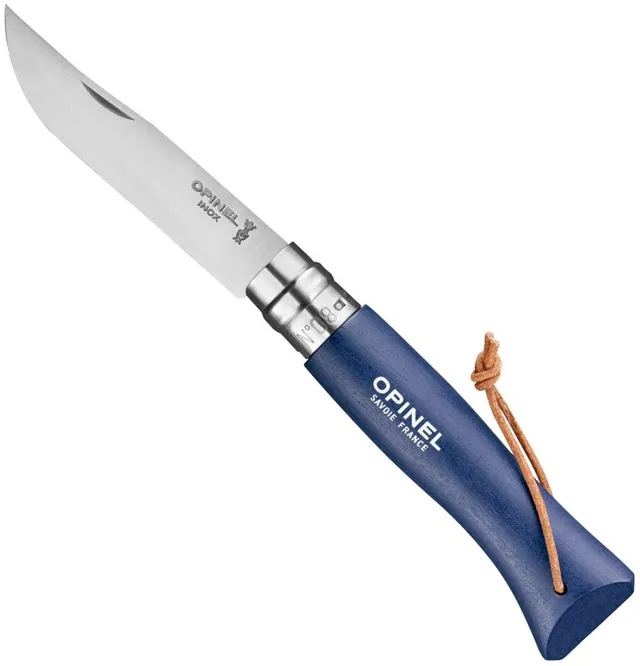
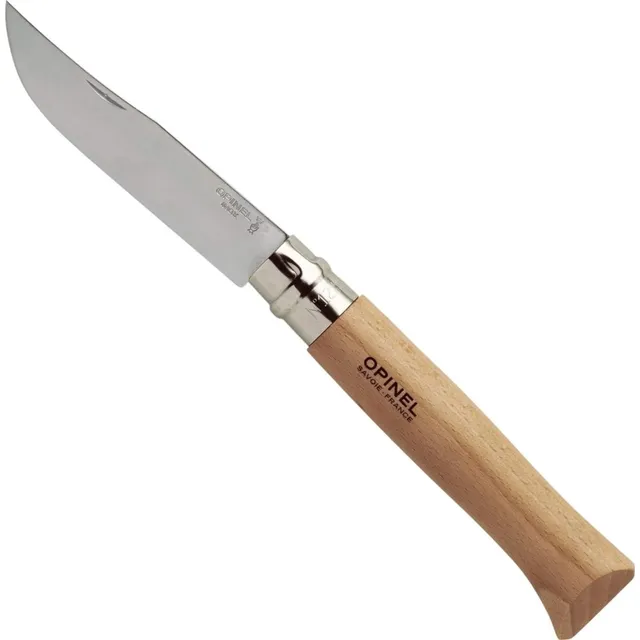
And if you simply want stainless convenience in the classic beech format without the premium finish, the Colorama No.08 at $27.60 splits the difference nicely, while campers and anyone who needs real blade length should look at the No.12 INOX instead — at 36 dollars it's Opinel's most capable do-it-all folding knife.
Whichever you choose, you're buying a knife made in France, backed by one of the oldest continuous cutlery traditions in Europe, and priced so fairly that the "right" answer genuinely comes down to how you live with your tools. That's rare in this category — and it's exactly why the No.08 deserves its reputation.